UEA 2019 — Questão 10 · Leitura e interpretação de texto
Leitura e interpretação de texto
UEA Macro 2019 · Inglês
Wood wide web: trees' social networks are mapped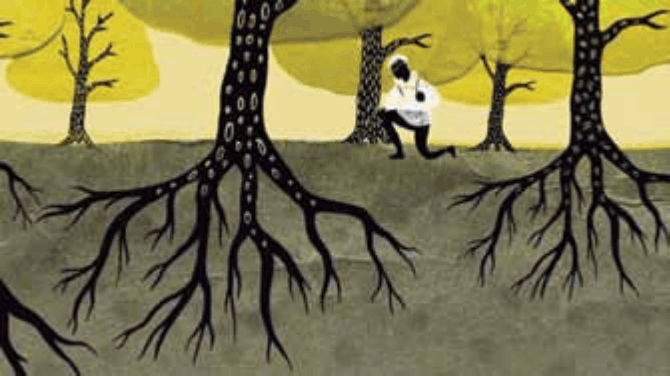 Research has shown that beneath every forest and wood there is a complex underground web of roots, fungi and bacteria helping to connect trees and plants to one another. This subterranean social network, nearly 500 million years old, has become known as the "wood wide web". Now, an international study has produced the first global map of the "mycorrhizal fungi networks" dominating this secretive world.
Using machine-learning, researchers from the Crowther Lab at ETH Zurich, Switzerland, and Stanford University in the US used the database of the Global Forest Initiative, which covers 1.2 million forest tree plots with 28,000 species, from more than 70 countries. Using millions of direct observations of trees and their symbiotic associations on the ground, the researchers could build models from the bottom up to visualise these fungal networks for the first time. Prof Thomas Crowther, one of the authors of the report, told the BBC, "It's the first time that we've been able to understand the world beneath our feet, but at a global scale."
The research reveals how important mycorrhizal networks are to limiting climate change — and how vulnerable they are to the effects of it. "Just like an Magnetic Resonance Imaging scan of the brain helps us to understand how the brain works, this global map of the fungi beneath the soil helps us to understand how global ecosystems work," said Prof Crowther. "What we find is that certain types of microorganisms live in certain parts of the world, and by understanding that we can figure out how to restore different types of ecosystems and also how the climate is changing." Losing chunks of the wood wide web could well increase "the feedback loop of warming temperatures and carbon emissions."
Mycorrhizal fungi are those that form a symbiotic relationship with plants. There are two main groups of mycorrhizal fungi: arbuscular fungi (AM) that penetrate the host's roots, and ectomycorrhizal fungi (EM) which surround the tree's roots without penetrating them.
(Claire Marshall. www.bbc.com, 15.05.2019. Adaptado.)
De acordo com o segundo e o terceiro parágrafos, os pesquisadores
Research has shown that beneath every forest and wood there is a complex underground web of roots, fungi and bacteria helping to connect trees and plants to one another. This subterranean social network, nearly 500 million years old, has become known as the "wood wide web". Now, an international study has produced the first global map of the "mycorrhizal fungi networks" dominating this secretive world.Using machine-learning, researchers from the Crowther Lab at ETH Zurich, Switzerland, and Stanford University in the US used the database of the Global Forest Initiative, which covers 1.2 million forest tree plots with 28,000 species, from more than 70 countries. Using millions of direct observations of trees and their symbiotic associations on the ground, the researchers could build models from the bottom up to visualise these fungal networks for the first time. Prof Thomas Crowther, one of the authors of the report, told the BBC, "It's the first time that we've been able to understand the world beneath our feet, but at a global scale."
The research reveals how important mycorrhizal networks are to limiting climate change — and how vulnerable they are to the effects of it. "Just like an Magnetic Resonance Imaging scan of the brain helps us to understand how the brain works, this global map of the fungi beneath the soil helps us to understand how global ecosystems work," said Prof Crowther. "What we find is that certain types of microorganisms live in certain parts of the world, and by understanding that we can figure out how to restore different types of ecosystems and also how the climate is changing." Losing chunks of the wood wide web could well increase "the feedback loop of warming temperatures and carbon emissions."
Mycorrhizal fungi are those that form a symbiotic relationship with plants. There are two main groups of mycorrhizal fungi: arbuscular fungi (AM) that penetrate the host's roots, and ectomycorrhizal fungi (EM) which surround the tree's roots without penetrating them.
(Claire Marshall. www.bbc.com, 15.05.2019. Adaptado.)
De acordo com o segundo e o terceiro parágrafos, os pesquisadores
Alternativas
- Aperceberam que as espécies de animais e vegetais formam um todo simbiótico.
- Bidentificaram 28 mil espécies de fungos e bactérias nas florestas estudadas.
- Cutilizaram informações da Global Forest Initiative, que abrange florestas de mais de 70 países.
- Drelataram que o mundo subterrâneo de microrganismos e raízes cria grupos de árvores do mesmo tipo.
- Ecriaram um mapa das florestas, identificando as espécies de árvores e animais que se comunicam.
Consulte a resposta
Visitantes podem consultar seis questões. Com uma conta gratuita, consulte até 20 por dia; no plano pago, todas sem limite.
Fonte: UEA Macro 2019 · Consultar referência